



When comparing stainless steel cookware, the difference between tri-ply base cookware and fully clad cookware is not simply the number of metal layers. It is where those layers extend.
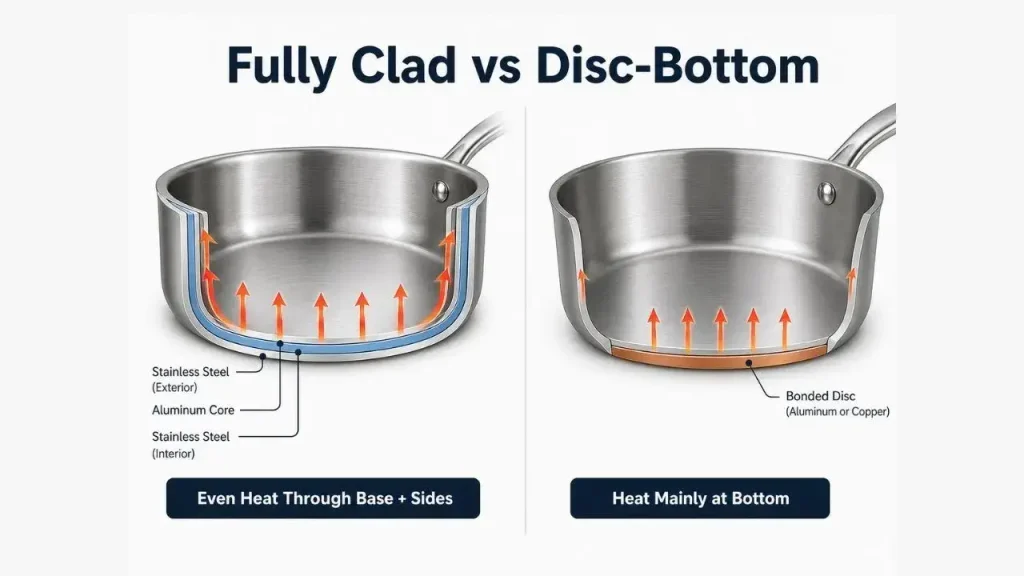
Tri-ply base cookware has a three-layer composite structure concentrated at the bottom, while fully clad cookware extends its bonded layers through both the base and sidewalls.
Both constructions combine stainless steel with a conductive core, typically aluminum, but they serve different product requirements. Understanding their structural and manufacturing differences helps cookware brands, importers, and manufacturers select the right construction for their target applications and cost requirements.
What Do Tri-Ply Base and Fully Clad Cookware Actually Mean?
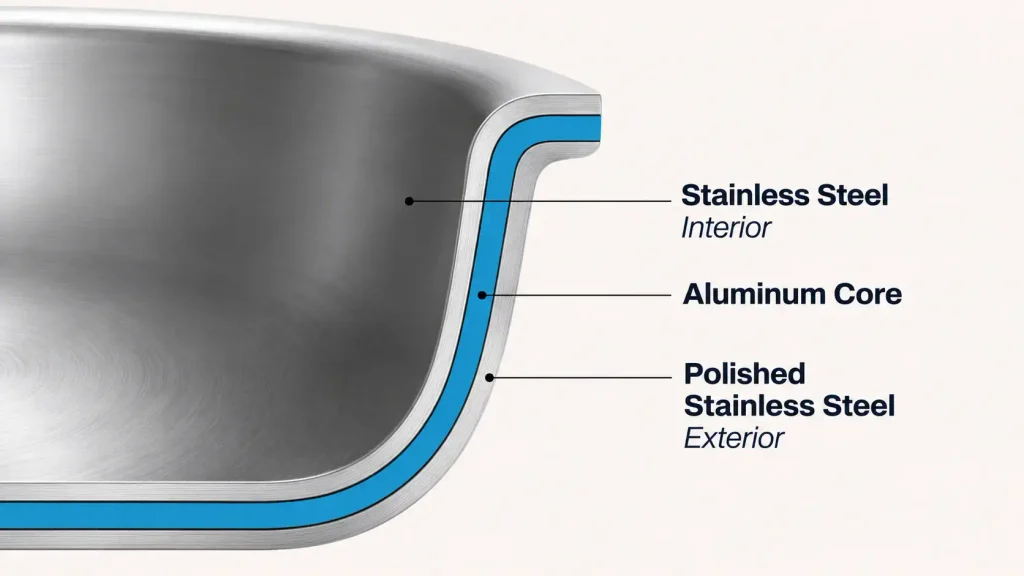
The term tri-ply refers to three bonded metal layers. A common construction combines:
- Stainless steel interior: Provides a durable cooking surface.
- Aluminum core: Improves heat conductivity.
- Stainless steel exterior: Provides structural support and the required exterior properties.
However, the term tri-ply does not automatically indicate full-body construction.
Tri-Ply Base Cookware
In tri ply base cookware, the three-layer composite structure is concentrated at the bottom of the vessel. The cookware body above the base is generally made from single-layer stainless steel.
This construction combines a conductive composite base with a simpler stainless steel body.
Fully Clad Tri-Ply Cookware
In fully clad tri ply cookware, the bonded metal layers extend from the bottom through the sidewalls, typically reaching the rim.
The aluminum core therefore extends beyond the base, allowing heat to spread through more of the cookware body.
How Are Tri-Ply Base and Fully Clad Cookware Made?
The two constructions differ not only in layer coverage but also in their typical manufacturing routes.
Tri-Ply Base Cookware: Composite Disc Attachment
A common production process involves:
- Forming the stainless steel cookware body.
- Preparing a three-layer composite stainless steel disc.
- Positioning the disc at the bottom of the cookware.
- Bonding or attaching the composite base using an appropriate process, such as impact bonding.
- Completing finishing and quality inspections.
Hengguang’s published three-piece tri-ply cookware set describes a stainless steel body with a three-layer composite bottom using triple impact-bonding technology.
See the tri-ply stainless steel cookware set with an impact-bonded base as a product example.
Fully Clad Cookware: Full-Sheet Bonding and Forming
Fully clad cookware generally starts with bonded composite metal sheets.
The typical production route includes:
- Bonding stainless steel and aluminum layers through roll cladding.
- Cutting the bonded sheet into suitable blanks.
- Forming the blanks into cookware bodies through stamping or deep drawing.
- Trimming, finishing, and assembling the products.
Because the layers are already bonded across the sheet, they can remain continuous through the base and sidewalls after forming.
A Tri-Ply Disc Is Not Necessarily a Base-Only Product
This distinction matters to cookware manufacturers.
A tri-ply disc is a composite raw material, not a fixed finished-product construction. Depending on its dimensions, material properties, and forming process, it may be used as a separate cookware base or as a blank for forming a body with layered sidewalls.
Tri-Ply Base vs. Fully Clad Cookware: Key Differences
The following table summarizes the main construction differences.
| Comparison | Tri-Ply Base | Fully Clad |
|---|---|---|
| Layer coverage | Bottom only | Bottom and sidewalls |
| Cookware body | Generally single-layer stainless steel | Multi-layer bonded construction |
| Aluminum core | Concentrated in the base | Extends through the walls |
| Base structure | Separate composite disc | Continuous layered construction |
| Sidewall heat distribution | More limited conductive core coverage | Conductive core extends through sidewalls |
| Manufacturing | Composite base attachment | Bonded sheet forming |
| Material use | Generally more concentrated in the base | More composite material throughout the body |
| Cost positioning | Often more economical | Generally higher material and processing requirements |
Neither construction is automatically superior.
Tri-ply base cookware can provide effective bottom heating without requiring composite layers throughout the vessel. Fully clad cookware offers more extensive conductive coverage, which can be useful when heat distribution through the sidewalls matters.
Actual manufacturing cost depends on material grades, thickness, product dimensions, production volume, and processing efficiency.
How Construction Affects Heat Distribution and Cooking Performance
The main functional difference comes from the location of the aluminum core.
Aluminum conducts heat more effectively than stainless steel. Its position within the cookware therefore influences how heat spreads.
Heat Distribution in Tri-Ply Base Cookware
In tri-ply base cookware, the aluminum core helps distribute heat across the bottom of the vessel.
This construction can work well for applications where most heat transfer occurs through the base, including boiling water, cooking pasta, and preparing soups.
However, the stainless steel sidewalls do not contain the same continuous aluminum core. Heat spreads into these walls through conduction from the base and, depending on the heat source, direct exposure to the flame.
Heat Distribution in Fully Clad Cookware
Fully clad construction extends the aluminum core through the sidewalls.
This allows heat to spread through a larger portion of the cookware body, which can be useful when ingredients or liquids contact the walls during cooking.
It is particularly relevant for:
- Reducing sauces.
- Sautéing ingredients.
- Simmering thicker mixtures.
- Cooking foods that frequently contact the sidewalls.
However, full cladding does not guarantee perfectly uniform heating. Actual performance also depends on the total thickness, aluminum-core thickness, vessel geometry, burner size, and heat input.
What About Induction Compatibility?
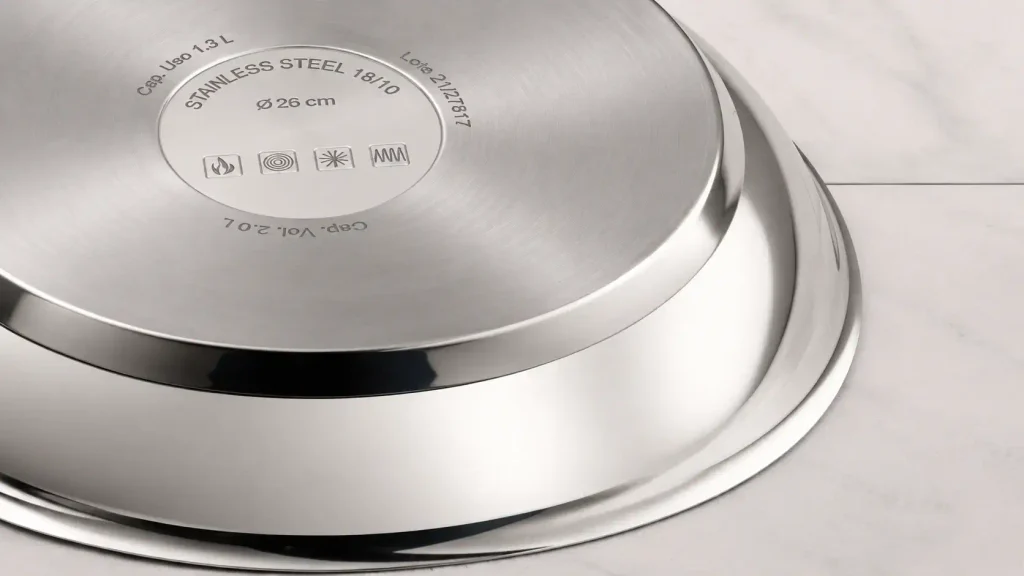
Induction compatibility depends on the magnetic properties and design of the cookware base, not simply whether the product is fully clad.
A tri-ply base can be induction-compatible when it incorporates a suitable magnetic stainless steel layer.
Which Construction Fits Different Cookware Applications?
The right construction depends on how the cookware will be used, rather than on the assumption that more cladding always produces a better product.
| Cookware Application | Construction to Consider | Reason |
|---|---|---|
| Stockpots | Tri-Ply Base | Often suitable for boiling and liquid-based cooking where bottom heating is central |
| Pasta Pots | Tri-Ply Base | Primarily used for heating and boiling liquids |
| Soup Pots | Either | Depends on wall heating requirements and product positioning |
| Sauce Pans | Either / Fully Clad | Fully clad can provide more controlled heat distribution through the walls |
| Frying Pans | Either / Fully Clad | Base construction is important for searing; full cladding adds sidewall heat distribution |
| Sauté Pans | Fully Clad | Useful when ingredients frequently contact the sidewalls |
| Sauciers | Fully Clad | More extensive conductive coverage can benefit sauce preparation and reduction |
When Tri-Ply Base Is a Practical Choice
Tri-ply base construction can be suitable when:
- The main cooking activity occurs at the bottom.
- The product is designed primarily for boiling or liquid-based cooking.
- Material efficiency and cost positioning are important.
- The intended market does not require full-body cladding.
When Fully Clad Is Worth Considering
Fully clad construction can be more suitable when:
- Cooking frequently involves the sidewalls.
- More extensive heat distribution is a product priority.
- The cookware is designed for sautéing, sauces, or similar applications.
- The product positioning supports the additional material and manufacturing requirements.
For manufacturers developing a cookware range, the decision should be made at the individual product level rather than applying one construction to every item.
How Buyers Can Identify and Specify the Correct Construction
For wholesale buyers, a product description stating only “tri-ply stainless steel” is not enough to establish the actual construction.
How to Identify the Construction
There are several practical ways to check:
1. Inspect the bottom edge
A separate composite base may have a visible boundary where the disc meets the cookware body. However, finishing processes can make this boundary less obvious.
2. Examine the rim cross-section
A fully clad product may show multiple bonded layers extending through the rim. This is a useful visual indicator, although a technical drawing provides stronger confirmation.
3. Request a cross-sectional drawing
Ask the manufacturer to show the base and sidewall construction, including the location of each material layer.
4. Check the product specification
Confirm whether the description explicitly states:
- Three-layer base construction.
- Fully clad construction.
- Bonded layers extending through the sidewalls.
A magnet test alone cannot establish whether cookware is fully clad. It can indicate magnetic material, but it does not reveal the complete layer structure.
What Should Buyers Include in an RFQ?
When sourcing tri-ply cookware or composite materials, specify:
| Specification | Information to Confirm |
|---|---|
| Layer coverage | Base only or full body |
| Inner material | Stainless steel grade |
| Core material | Aluminum or another specified conductive metal |
| Exterior material | Stainless steel grade |
| Total thickness | Overall material thickness |
| Individual layers | Thickness of each bonded layer |
| Bonding method | Impact bonding, roll bonding, or another process |
| Product dimensions | Diameter, height, shape, and base dimensions |
| Compatibility | Intended cooktop and product application |
| Technical documentation | Drawings, specifications, and relevant test records |
Hengguang’s published tri-ply disc offering lists 304/316 stainless steel, aluminum, and 430 stainless steel, with optional total thicknesses of 1.8 mm, 2.0 mm, 2.2 mm, 2.5 mm, and 3.0 mm.
These are options for the referenced raw-material product, not universal specifications for every finished cookware model.
Conclusion
The key difference between tri-ply base and fully clad cookware is layer coverage, not simply layer count.
Tri-ply base construction concentrates the conductive core at the bottom, while fully clad construction extends it through the sidewalls.
For cookware manufacturers and sourcing buyers, the best choice depends on the intended application, required heating performance, material specifications, and manufacturing cost.
Understanding these differences before product development helps ensure that the selected construction matches the product’s actual requirements.